

Blog
PEEK for Humanoid Robots: Applications and Benefits

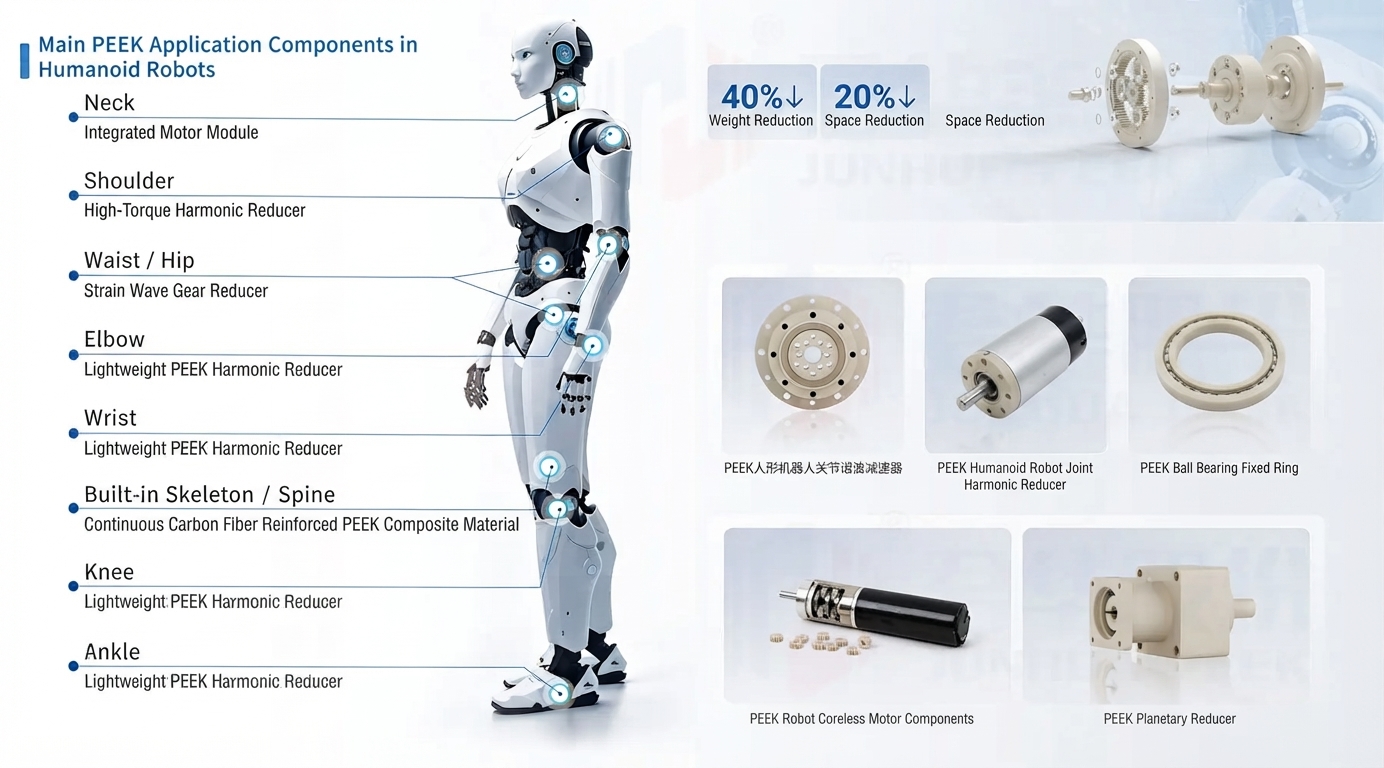
Humanoid robots are becoming increasingly compact, precise, and capable of performing complex movements. As robot designs continue to evolve, material selection has become an important consideration for improving weight, durability, motion accuracy, and overall reliability.
While metals remain essential for major structural and load-bearing components, many smaller parts inside a humanoid robot require a different combination of properties. Gears, bushings, guides, bearing components, insulating parts, and sensor supports may benefit from lightweight, wear-resistant, and electrically insulating materials.
PEEK (Polyether Ether Ketone) is one high-performance engineering plastic that can meet many of these requirements.
Why Is PEEK Suitable for Humanoid Robots?
PEEK combines several properties that are valuable in compact robotic mechanisms.
Lightweight Construction
Reducing the mass of moving components can help lower inertia and reduce the load placed on robotic actuators.
This can be particularly important in moving assemblies such as robotic hands, wrists, arms, and joint mechanisms. PEEK has a significantly lower density than many metals while maintaining high mechanical performance, making it suitable for selected lightweight components.
Excellent Wear Resistance
Robotic mechanisms can experience thousands or even millions of repeated movements.
Gears, bushings, sliding guides, and other contact components are exposed to continuous friction and wear. PEEK offers good wear resistance, and specialized grades can be formulated for demanding sliding applications.
Low Friction
Friction directly affects energy loss, heat generation, noise, and component life.
PEEK can provide useful friction characteristics in properly designed applications, particularly when combined with an appropriate mating material and operating condition.
For this reason, PEEK is often considered for bushings, sliding components, bearing cages, and other moving parts.
Electrical Insulation
Humanoid robots combine mechanical systems with motors, batteries, sensors, controllers, and wiring in a relatively small space.
PEEK is an electrically insulating material and can therefore be used for selected electrical supports, sensor mounts, cable guides, connectors, and insulating components where mechanical performance is also required.
High-Temperature and Chemical Resistance
PEEK maintains useful mechanical properties at elevated temperatures and has excellent resistance to many chemicals.
These characteristics can be valuable for robotic components located near motors, actuators, electrical systems, or other heat-generating components.
PEEK Applications in Humanoid Robots
PEEK is not intended to replace every metal component in a humanoid robot. Its value is more apparent in specific components where its combination of properties provides an engineering advantage.
PEEK Gears
Small gears are used throughout robotic transmission systems.
For selected low- to medium-load applications, PEEK gears can provide lower weight and good wear performance while potentially reducing mechanical noise.
The appropriate material grade depends on factors such as torque, rotational speed, temperature, lubrication, tooth design, and expected service life.
For highly loaded transmission systems, reinforced PEEK or metal may be more appropriate.
Bushings and Sleeves
Bushings and sleeves are common applications for engineering plastics.
They can be used around shafts, pivots, and other moving interfaces where low friction, wear resistance, dimensional stability, and reduced weight are important.
PEEK can be particularly useful when the component must operate under elevated temperatures or in chemically demanding environments.
Robotic Hands
Humanoid hands contain many small moving components within a limited space.
Depending on the design, PEEK can be considered for:
- Small gears
- Pulleys
- Bushings
- Spacers
- Cable guides
- Linkage components
- Insulating supports
Reducing the weight of these components can help minimize moving inertia, while the wear resistance of PEEK can support repeated movement.
Bearing Cages and Spacers
Bearing cages, washers, spacers, and similar components may appear relatively small, but they can have an important influence on mechanical performance.
PEEK can provide a combination of dimensional stability, wear resistance, low weight, and electrical insulation for selected applications.
The final selection should consider load, speed, temperature, lubrication, and clearance requirements.
Cable Guides and Sensor Supports
Humanoid robots require extensive cable routing for motors, sensors, and electronic systems.
Cable guides and supports must withstand repeated movement while protecting cables from excessive friction and abrasion.
PEEK can also be used for selected sensor mounts and electronic supports where dimensional stability and electrical insulation are required.
PEEK Grades for Robotic Components
Different robotic components may require different PEEK formulations.
Virgin PEEK provides a balanced combination of mechanical properties, chemical resistance, dimensional stability, and electrical insulation.
Carbon Fiber Reinforced PEEK offers increased stiffness and reduced deformation and can be considered for components requiring greater mechanical rigidity.
Glass Fiber Reinforced PEEK can provide improved stiffness and dimensional stability for selected structural and support applications.
Wear-Modified PEEK is designed for applications where friction and wear performance are particularly important.
Therefore, choosing PEEK is only the first step. The material grade should be selected according to the actual operating conditions of the component.
PEEK vs. Metal in Humanoid Robotics
PEEK should not be viewed simply as a replacement for metal.
Metal remains important for major frames, shafts, high-load structural components, and heavily loaded transmission systems.
PEEK becomes more attractive when the component requires a combination of:
- Lower weight
- Wear resistance
- Low friction
- Electrical insulation
- Chemical resistance
- Dimensional stability
- High-temperature performance
The best material depends on the function of the individual component.
In some applications, a metal component may provide the required strength. In others, PEEK can reduce weight or provide better friction, insulation, or wear characteristics.
Manufacturing PEEK Components for Robotics
Material performance is only one part of the equation. Manufacturing accuracy is also important for robotic components.
PEEK can be supplied in semi-finished forms such as sheets, rods, and tubes and can be machined into customized components.
For precision robotic parts, engineers should consider:
- Material grade
- Dimensional tolerances
- Thermal expansion
- Machining method
- Surface finish
- Assembly clearance
- Operating temperature
- Final inspection requirements
For complex or low-volume robotic components, CNC machining can provide a practical way to produce customized PEEK parts without requiring dedicated tooling.
Conclusion
PEEK offers a combination of lightweight construction, wear resistance, low friction, electrical insulation, chemical resistance, and high-temperature performance that can be valuable in humanoid robotics.
Potential applications include gears, bushings, sleeves, bearing components, robotic-hand parts, cable guides, sensor supports, and insulating components.
However, PEEK is not a universal replacement for metal. The correct material depends on the load, speed, temperature, friction, wear, tolerance, and service requirements of each component.
With the appropriate PEEK grade and manufacturing process, high-performance polymer components can help engineers develop lighter, more durable, and more reliable robotic mechanisms.