

Blog
PEEK vs PPS Cost: Understanding the Real Value of High Performance Plastics

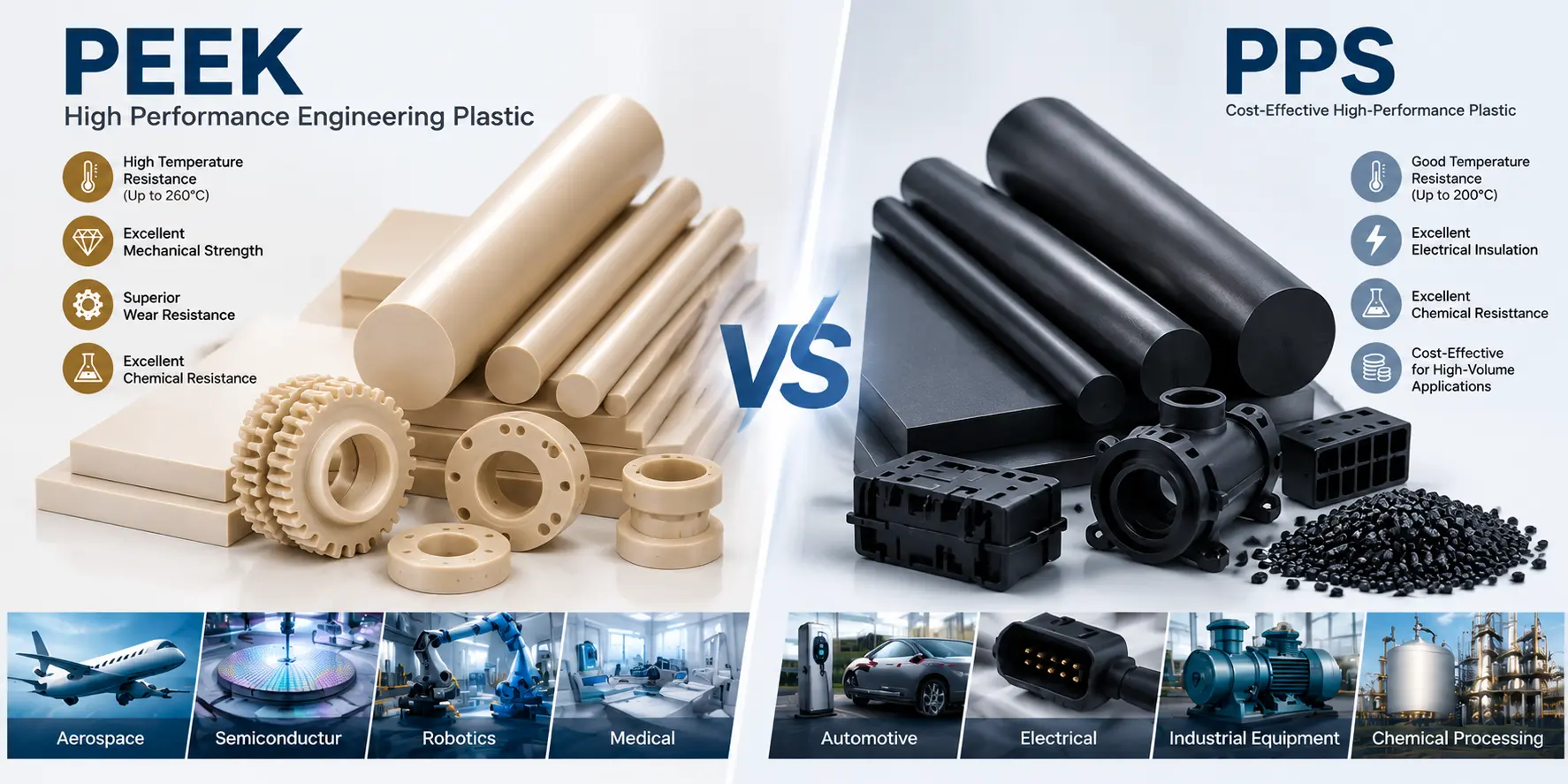
PEEK and PPS are two widely used high-performance engineering plastics known for their excellent temperature resistance, chemical stability and dimensional reliability.
However, one of the biggest differences between these materials is cost.
PEEK is generally positioned as a premium engineering polymer with higher performance capabilities, while PPS provides a more cost-effective solution for applications where extreme performance is not required.
Choosing between PEEK and PPS is not only about material price. The right selection depends on operating conditions, component requirements and long-term performance expectations.
Why Is PEEK More Expensive Than PPS?
PEEK (Polyether Ether Ketone) is one of the highest-performance thermoplastics available today.
Compared with PPS, PEEK provides:
- Higher continuous service temperature
- Better fatigue resistance
- Superior wear resistance
- Higher mechanical strength
- Excellent creep resistance
- Outstanding chemical resistance
These advantages make PEEK suitable for demanding applications such as:
- Aerospace components
- Semiconductor equipment
- Medical devices
- Oil and gas components
- High-performance mechanical parts
However, these properties also come with higher production costs.
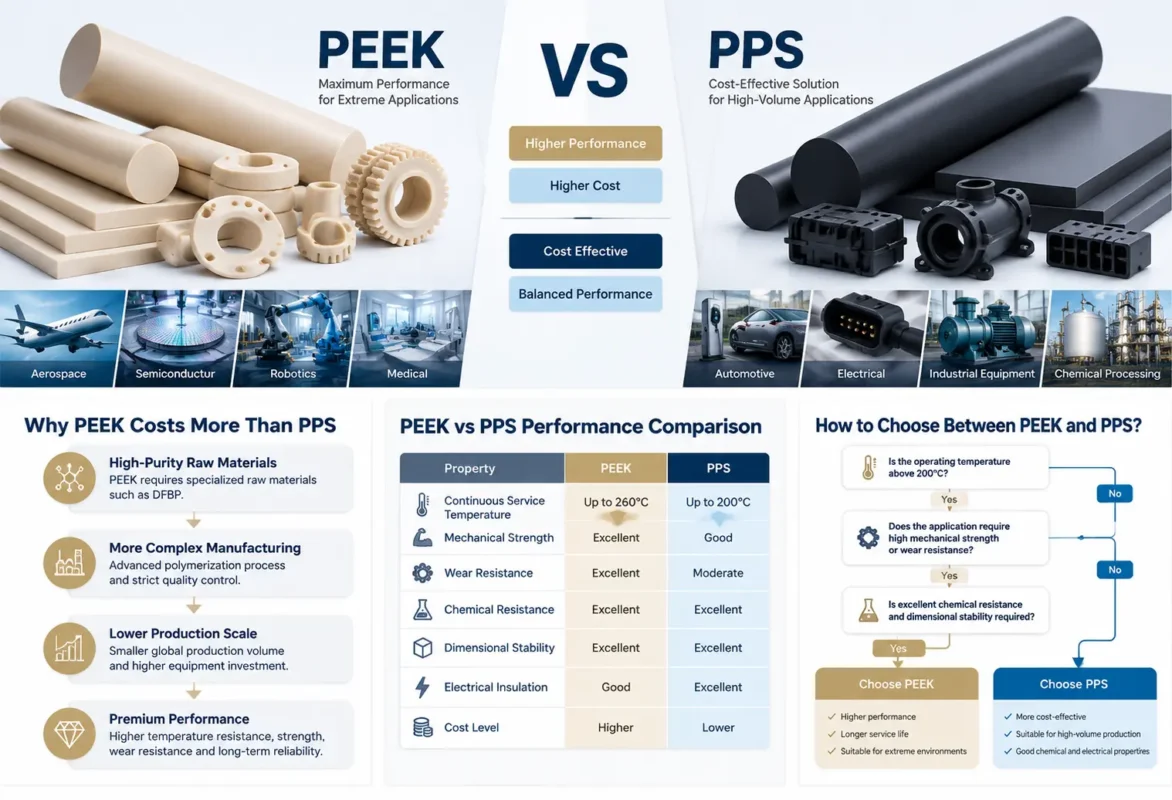
What Makes PEEK Cost Higher?
1. Complex Polymer Manufacturing
PEEK requires more advanced polymerization technology compared with standard engineering plastics.
The manufacturing process involves:
- High-purity raw materials
- Strict reaction control
- Advanced processing technology
These factors contribute to higher production costs.
2. Limited Production Scale
Compared with PPS, PEEK has historically had a smaller production volume and fewer global suppliers.
Lower production scale means:
- Higher manufacturing investment
- Higher equipment costs
- Higher material costs
3. Performance Value
The higher price of PEEK is mainly related to the performance it provides.
In many applications, PEEK replaces:
- Stainless steel
- Aluminum
- Titanium
- Other high-performance materials
The real evaluation should not only consider material price, but also:
- Service life
- Maintenance requirements
- Downtime risk
- Total operating cost
PPS: A Cost-Effective Alternative to PEEK
PPS (Polyphenylene Sulfide) is another high-performance thermoplastic widely used in industrial applications.
Compared with PEEK, PPS offers:
- Lower material cost
- Excellent chemical resistance
- Good dimensional stability
- Good electrical insulation performance
- High temperature capability
Typical PPS applications include:
- Automotive electrical components
- Connectors
- Pump components
- Semiconductor parts
- Industrial equipment
For many applications, PPS provides an excellent balance between performance and cost.
PEEK vs PPS Cost Comparison
| Property | PEEK | PPS |
|---|---|---|
| Material Cost | Higher | Lower |
| Temperature Resistance | Excellent | Very Good |
| Mechanical Strength | Excellent | Good |
| Wear Resistance | Excellent | Moderate |
| Chemical Resistance | Excellent | Excellent |
| Dimensional Stability | Excellent | Excellent |
| Cost Efficiency | Premium Performance | Cost Optimization |
When Should You Choose PEEK Instead of PPS?
PEEK is usually preferred when the application requires:
High Mechanical Loads
Examples:
- Bearings
- Bushings
- Gears
- Wear rings
PEEK provides better creep resistance and long-term mechanical stability.
Extreme Temperature Conditions
Choose PEEK for applications requiring:
- Continuous high-temperature operation
- Thermal cycling resistance
- Long service life
Friction and Wear Applications
PEEK grades reinforced with:
- Carbon fiber
- Glass fiber
- PTFE
are commonly used for:
- Sliding components
- Sealing parts
- Dry-running bearings
When Is PPS the Better Choice?
PPS is often the better option when:
- Production volume is high
- Cost control is important
- Extreme mechanical performance is unnecessary
Typical examples:
- EV electrical components
- Precision housings
- Insulation parts
- Chemical-resistant components
Are Lower PEEK Prices Changing Material Selection?
The future development of PEEK manufacturing may gradually expand its application range.
As production technology improves and supply chains mature, PEEK may become more accessible for applications that previously selected lower-cost materials.
This could create new opportunities in:
- Humanoid robotics
- Semiconductor manufacturing
- Electric vehicles
- Medical equipment
- Additive manufacturing
However, PEEK will not simply replace PPS.
The two materials serve different engineering requirements:
PEEK = Maximum performance
PPS = Optimized performance-to-cost ratio
How to Select Between PEEK and PPS?
Before choosing the material, consider:
Temperature
Higher temperature requirements → PEEK
Moderate temperature requirements → PPS
Mechanical Load
High load / long-term stress → PEEK
General structural applications → PPS
Wear Requirements
Friction applications → PEEK
Static components → PPS
Cost Target
Performance priority → PEEK
Cost efficiency priority → PPS
Conclusion
PEEK and PPS are not direct substitutes. They are complementary high-performance engineering plastics.
PEEK provides higher mechanical performance, wear resistance and temperature capability for critical applications.
PPS offers an excellent balance of performance and cost for high-volume industrial applications.
The best material choice depends on the actual working environment, not only the initial material price.
FAQ
Is PEEK more expensive than PPS?
Yes. PEEK is generally more expensive than PPS because it provides higher mechanical performance, temperature resistance and long-term durability.
Can PPS replace PEEK?
In some applications, yes. PPS can replace PEEK when extreme temperature, wear or mechanical performance is not required.
Which material is better, PEEK or PPS?
Neither material is universally better. PEEK is better for extreme performance requirements, while PPS provides better cost efficiency.
Why is PEEK expensive?
PEEK costs more due to complex manufacturing processes, specialized raw materials and higher performance capability.