Blog
PEEK Materials for Offshore Wind Turbines: Lowering LCOE & Unscheduled Maintenance

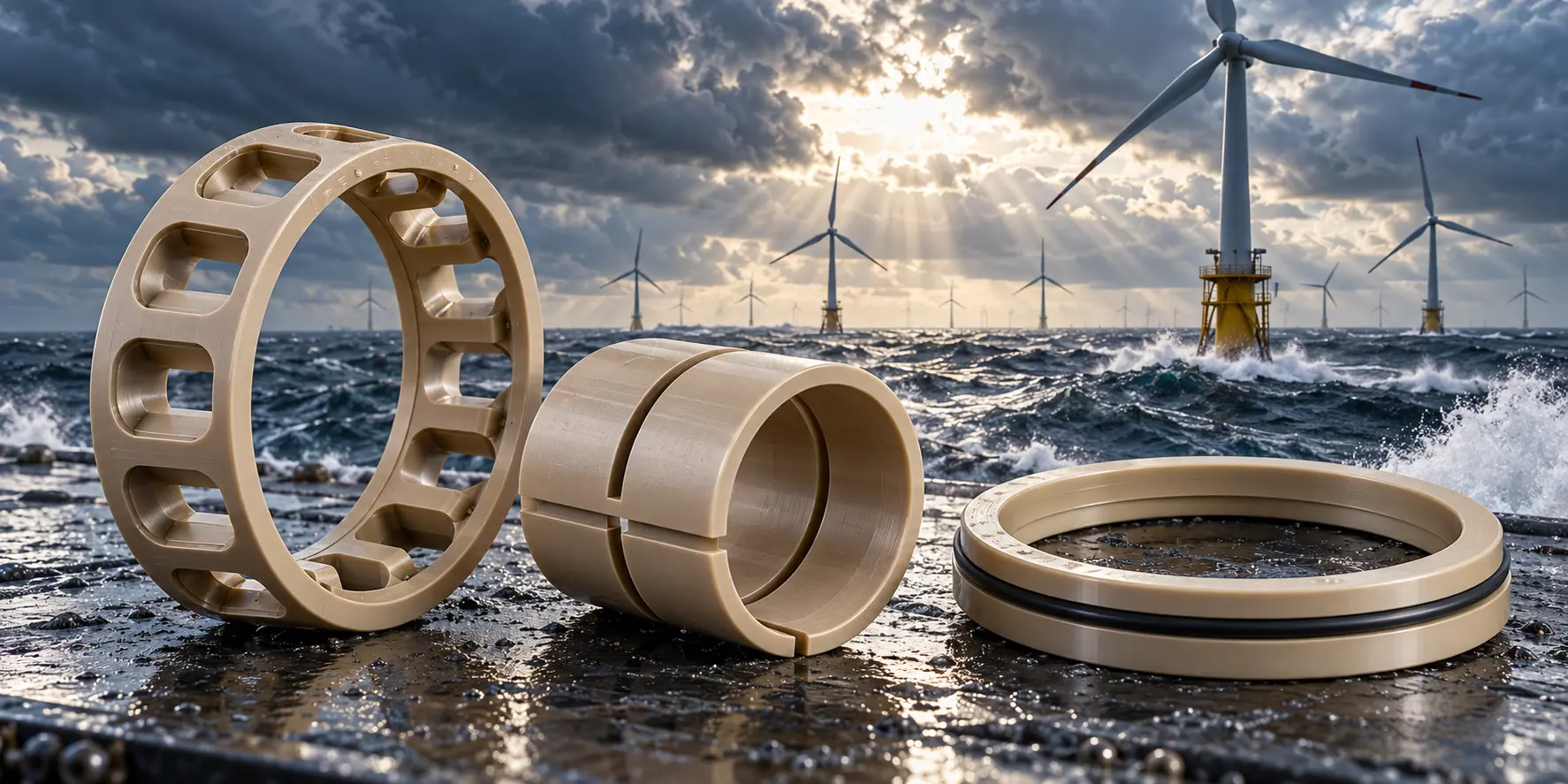
As offshore wind platforms scale beyond 15 MW and deploy into deep-water environments, unscheduled maintenance has become the single largest threat to project Levelized Cost of Energy (LCOE).
Mobilizing an offshore service vessel (SOV) and specialized crews to repair minor mechanical failures routinely costs €30,000 to €80,000 per day, compounded by severe revenue losses from power generation downtime.
While marinized steels, bronzes, and conventional elastomers degrade under aggressive chloride exposure, wave fatigue, and grease starvation, Polyetheretherketone (PEEK) high-performance polymers offer a robust, maintenance-free engineering solution.
Below is an engineering analysis of the critical mechanical and tribological challenges in offshore wind turbines that PEEK components resolve.
1. Eliminating Marine Corrosion & Sacrificial Anode Maintenance
- The Operational Bottleneck:
Offshore nacelles and submerged structures endure extreme C5-M / CX marine atmospheric corrosion. Metallic bushings, valve seats, and structural fasteners rely heavily on protective paints, grease packing, or sacrificial zinc anodes. Once coatings are damaged by mechanical micro-vibrations, crevice and galvanic corrosion trigger stress-corrosion cracking (SCC). - The PEEK Solution:
PEEK is inherently hydrophobic (water absorption <0.1%) and chemically inert against saltwater, brine spray, and industrial cleaning solvents. Eliminating sacrificial oxidation mechanisms extends the operational service life of splash-zone and subsea components to match the 25-year turbine design life.
2. High-PV Self-Lubrication: Ending Grease Starvation in Pitch & Yaw Systems
- The Operational Bottleneck:
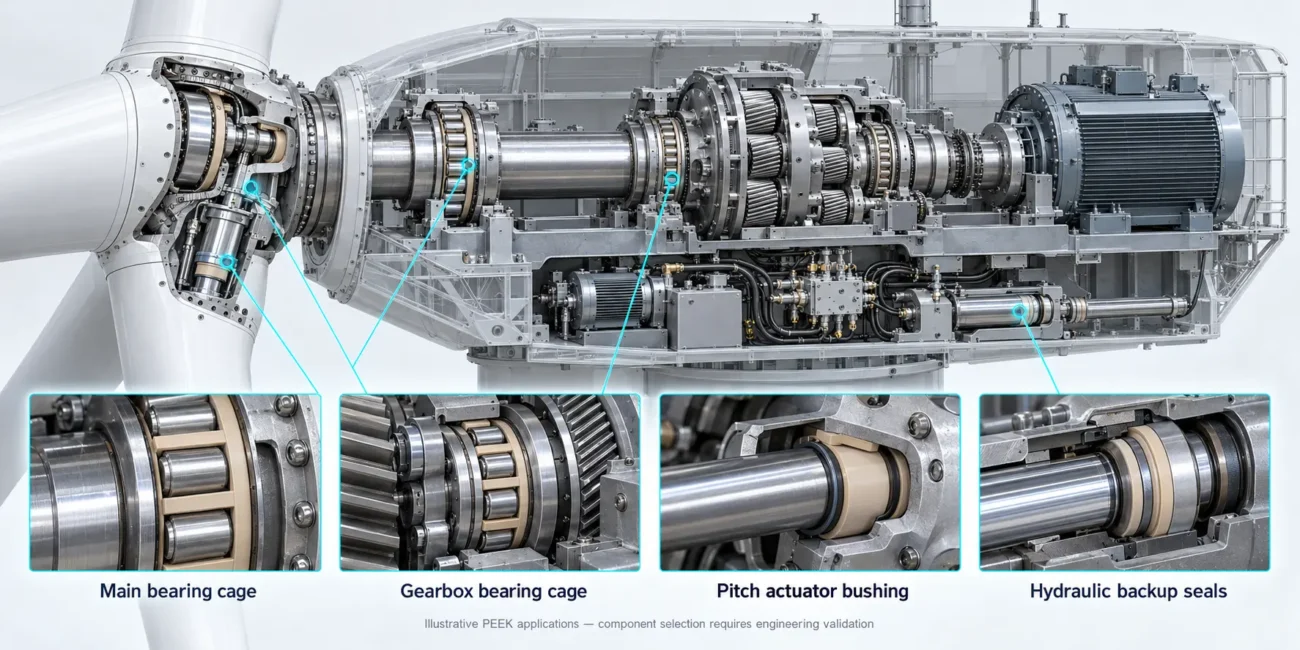
Blade pitch and nacelle yaw mechanisms endure continuous oscillatory motion under violent wind turbulence. Conventional bronze bushings operating in boundary lubrication suffer from grease wash-out and starvation, leading to fretting wear, micro-galling, and dangerous torque spikes. - The PEEK Solution:
Internally lubricated PEEK compounds (formulated with carbon fiber, PTFE, and solid graphite) deliver low friction coefficients (μ as low as 0.08–0.15 under dry contact).- They run 100% lube-free, completely eliminating automated central lubrication pumps, complex grease lines, and the environmental risk of grease discharge into marine sanctuaries.
3. Gearbox Reliability: Suppressing Bearing Cage Failures (WEC Protection)
- The Operational Bottleneck:
Wind gusts create dynamic torque reversals inside the main drivetrain. Conventional brass or machined-steel rolling element bearing cages fail prematurely due to high-acceleration slippage, pocket wear, and cage fatigue cracking—often accelerating catastrophic White Etching Cracks (WEC) on bearing raceways. - The PEEK Solution:
- Low Rotational Inertia: With a specific gravity of ~1.4 g/cm³ (one-sixth of brass and steel), PEEK cages slash rotational mass, eliminating roller skidding and scuffing during sudden wind gust accelerations.
- Thermal & Acid Resistance: PEEK withstands continuous sump temperatures up to 140°C and resists acidic degradation caused by aging gear oils and aggressive anti-wear additives.
4. High-Pressure Hydraulic Sealing: Preventing Extrusion Failures
- The Operational Bottleneck:
Hydraulic pitch actuators and subsea cable glands operate under extreme static pressures and continuous pressure pulsation. Conventional elastomeric seals (NBR, FKM) suffer from explosive decompression, thermal hardening, and high-pressure gap extrusion. - The PEEK Solution:
Virgin and reinforced PEEK serve as high-modulus backup rings and primary seal bodies. Retaining high yield strength under multi-axis pressure prevents gap extrusion, while low creep ensures leak-tight hydraulic containment across multi-million pressure cycles.
Application Matrix: PEEK vs. Legacy Materials in Offshore Wind Turbines
| Sub-System Component | Replaced Legacy Material | Critical Failure Mode Eliminated | PEEK Compound Specified |
| Pitch & Yaw Sliding Bushings | Phosphor Bronze, CuSn12 | Grease washout, fretting wear, saltwater galling | PEEK + Carbon Fiber + PTFE (Bearing Grade) |
| Main Shaft & Gearbox Cages | Machined Brass, Stamped Steel | Inertia roller skidding, WEC, cage fracture | Injection-Molded Virgin PEEK / PEEK-GF30 |
| Hydraulic Back-up Rings | Virgin PTFE, Polyurethane | Gap extrusion under high pressure, cold flow | High-Modulus Virgin PEEK (Unfilled) |
| Sensor & Slip-Ring Insulators | Epoxy Resins, Anodized Aluminum | Dielectric breakdown, moisture tracking, salt bridging | Virgin PEEK (830 V/mil dielectric strength) |
| Subsea Cable Clamps & Fasteners | 316L Stainless, Duplex Steel | Marine bio-fouling, crevice corrosion, magnetic flux | PEEK-CF30 (High Tensile Strength) |
Summary: Driving Down LCOE Through Material Resilience
Offshore wind asset managers no longer evaluate components solely by raw material purchase cost.
By replacing vulnerable metallic wear points with high-crystallinity PEEK, operators eliminate continuous offshore relubrication voyages, eradicate marine corrosion vectors, and dramatically extend Mean Time Between Failures (MTBF). PEEK transitions offshore wind components from high-maintenance liabilities into true 25-year “fit-and-forget” engineering assets.