

Blog
Engineering Guide: Polyphenylene Sulfide (PPS) vs. PEEK — High-Temperature Chemical Performance & Cost-Down Strategy

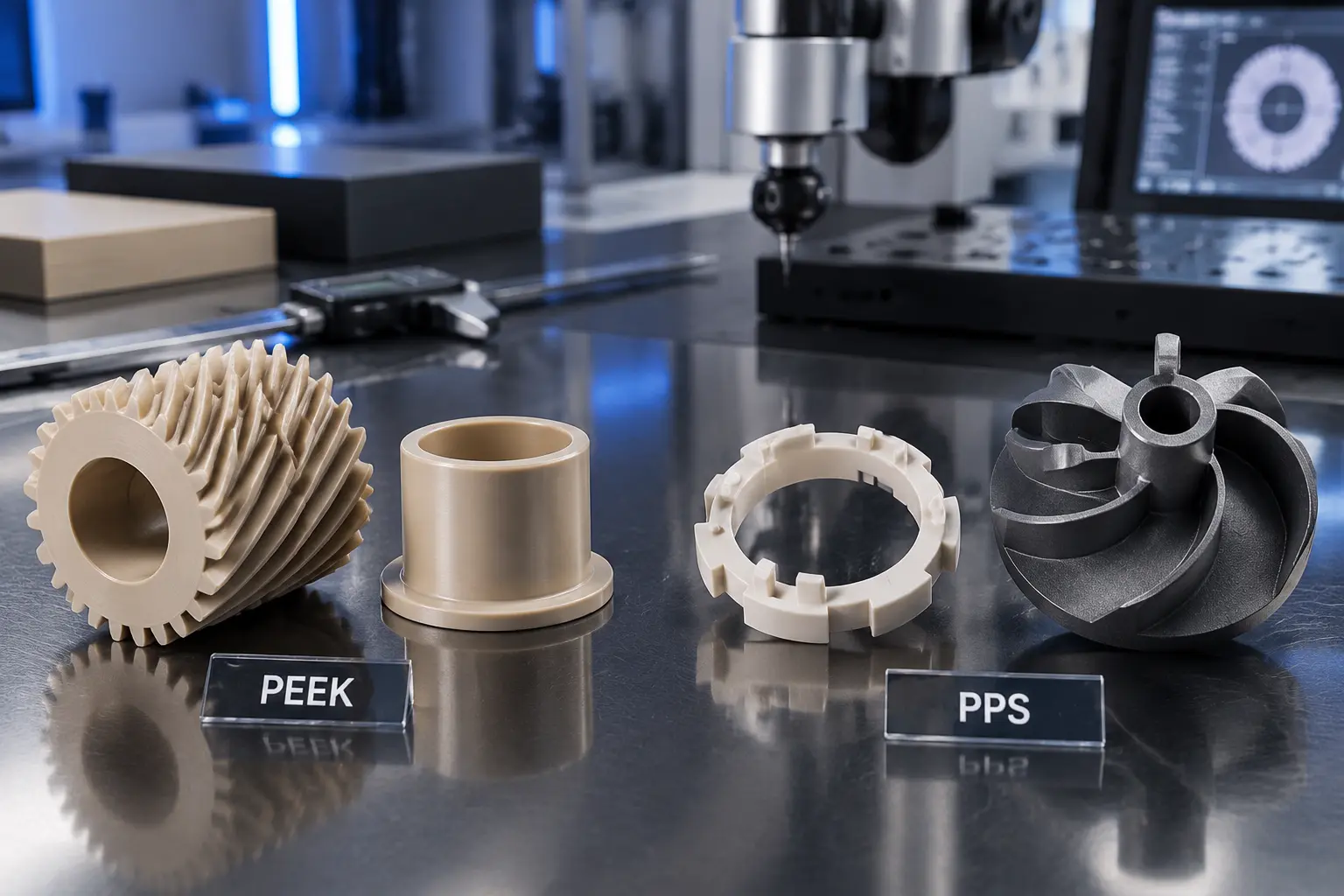
In mission-critical component design—spanning semiconductor wet benches, automotive thermal management, downhole energy tools, and industrial fluidics—materials engineers frequently default to PEEK for demanding thermal and chemical environments.
However, over-specifying PEEK often introduces unnecessary raw-material premiums that erode project margins.
Polyphenylene Sulfide (PPS) is an ultra-high-performance semicrystalline thermoplastic that matches or even exceeds PEEK’s chemical immunity at a 30% to 50% lower material cost, serving continuously at temperatures up to 200°C to 220°C (392°F to 428°F).
This engineering guide examines the molecular architecture of PPS, compares its key mechanical and tribological limits directly against PEEK, and delivers a definitive application decision framework for components operating in harsh fluids and elevated temperatures.
1. Molecular Backbone: Why PPS Has No Known Solvents Below 200°C
The chemical formula of PPS is (C₆H₄S)ₙ, featuring an alternating backbone of rigid aromatic benzene rings interconnected by thermal-stable thioether (sulfur) linkages:
-[Ph-S]ₙ- (where Ph represents an aromatic phenylene ring)
This compact, highly crystalline polymer structure delivers unique physical advantages:
- Universal Chemical Inertness: Below 200°C (392°F), PPS has no known commercial solvent. It resists prolonged exposure to concentrated acids (HCl, HNO₃, HF), strong alkalis (NaOH), and aggressive hydrocarbons where metals, polyamides, and even standard fluoropolymers fail.
- Near-Zero Moisture Absorption (<0.02%): PPS absorbs virtually zero moisture from ambient humidity or fluid submersion, eliminating the dimensional swelling and bore-binding common to Nylon (PA66) or Polyacetal (POM).
- Inherent Flame Retardancy (UL94 V-0): The high sulfur and aromatic carbon content makes virgin PPS inherently flame-resistant without the addition of halogenated fire-retardant additives.
2. Comprehensive Property Comparison: PPS vs. PEEK
Selecting between PPS and PEEK is governed by continuous service temperature thresholds and dynamic mechanical impact requirements.
| Engineering Property | Test Standard | Neat / Virgin PPS | 40% Glass-Filled PPS | Virgin PEEK | 30% Glass-Filled PEEK |
| Density (g/cm³) | ISO 1183 | 1.35 | 1.65 | 1.30 | 1.51 |
| Tensile Strength (MPa) | ISO 527 | 85 | 165 | 100 | 160 |
| Flexural Modulus (GPa) | ISO 178 | 3.8 | 14.0 | 3.8 | 9.5 |
| Heat Deflection Temp (HDT @ 1.8 MPa) | ISO 75 | 110°C | 260°C | 152°C | 315°C |
| Continuous Service Temp | UL 746B | 200°C – 220°C | 220°C | 250°C – 260°C | 260°C |
| Moisture Absorption (24 hr, %) | ISO 62 | <0.02% | <0.02% | 0.10% | 0.08% |
| Elongation at Break (%) | ISO 527 | 3.0% (Brittle) | 1.5% | >15% (Ductile) | 2.5% |
| Relative Material Cost Index | Commercial | Baseline (~0.5x) | ~0.6x | 1.0x (Reference) | ~1.3x |
3. Engineering Trade-Offs: When to Specify PPS Over PEEK
Scenario A: You Should Specify PPS If:
- Continuous Operating Temperatures are Below 200°C: If your operating thermal threshold never exceeds 200°C, paying a 100% premium for PEEK’s 250°C rating is over-engineering.
- Aggressive Chemical Baths & Slurry Immersion: In semiconductor CMP retaining rings and wet-process etching equipment, PPS delivers identical or superior chemical resistance against abrasive, highly acidic/alkaline slurries at substantially reduced tooling and consumable costs.
- Extreme Dimensional Rigidity is Required: Reinforced PPS (40% glass-filled) achieves a staggering 14 GPa flexural modulus, providing extreme structural stiffness and minimal creep under compressive load.
Scenario B: You Must Stay with PEEK If:
- Continuous Temperature Exceeds 220°C: PEEK operates continuously at 250°C–260°C and resists excursions up to 300°C.
- Dynamic Impact and High Shock Loads: Virgin PPS has low elongation at break (~3%), making it brittle under sudden mechanical shock or high-vibration bending. Unfilled PEEK offers high elongation (>15%) and superior fracture toughness.
- High Wear Tribological Sliding: While bearing-grade PPS compounds exist, carbon-fiber-reinforced PEEK delivers higher PV limits and lower wear factors against soft metal counter-faces.
4. Primary High-Reliability Target Applications
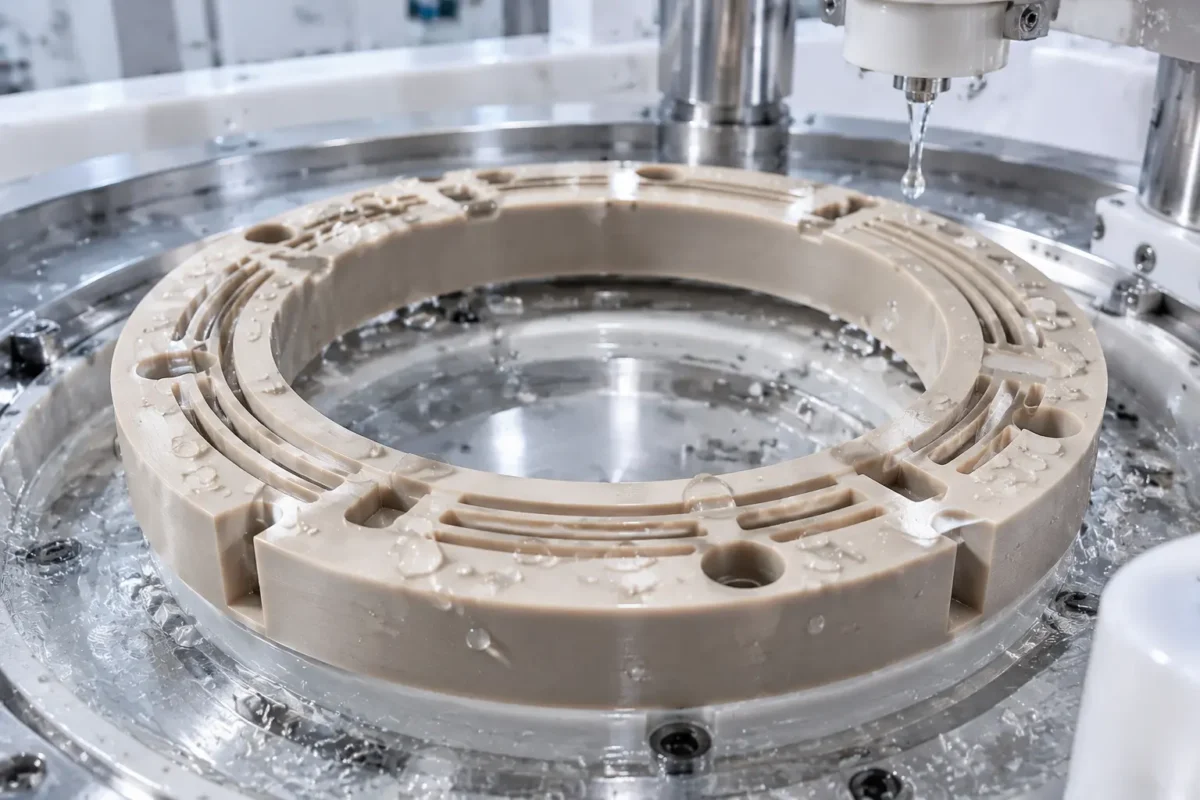
- Semiconductor CMP Retaining Rings: Virgin and bearing-grade PPS stock shapes machined into CMP rings provide uniform wear rates, zero slurry contamination, and excellent chemical resistance against caustic polishing media.
- Automotive EV Thermal Management & Coolant Pumps: Impellers, thermostat housings, and valve manifolds operating continuously in hot water/glycol mixtures up to 135°C without hydrolytic degradation.
- Industrial Chemical Metering & Fluid Handling: Precision-machined PPS pump gears, flowmeter bodies, and valve seats exposed to harsh acids, bleach (sodium hypochlorite), and caustic solutions.
- Electronic Connectors & Insulators: High dielectric strength (20 kV/mm) and high comparative tracking index (CTI) combined with dimensional stability during vapor-phase and lead-free wave soldering.
5. Best Practices for Precision CNC Machining of PPS
Machining extruded or compression-molded PPS plate and rod requires strict adherence to cutting dynamics due to its high crystallinity and notch sensitivity:
- Tooling: Always use sharp, positive-rake carbide tooling. For glass-filled PPS grades, polycrystalline diamond (PCD) inserts are strongly recommended to counter abrasive tool wear.
- Coolant Management: Flood coolant using water-soluble synthetic emulsions or clean air blasts. Never allow localized frictional heat to exceed 150°C during drilling, as localized overheating induces surface micro-crazing.
- Stress Relieving (Annealing): For tight-tolerance components (±0.01 mm), specify pre-machined stock shapes that have undergone programmed thermal annealing to eliminate residual extrusion stresses.
Summary: Balancing High-Duty Performance with Cost Efficiency
Modern precision manufacturing requires ruthless value engineering. By specifying Polyphenylene Sulfide (PPS) in applications where continuous temperatures remain under 200°C, design engineers secure the extreme chemical resistance, flame retardancy, and micron-level dimensional stability of ultra-polymers—while cutting component raw material costs by up to 50%.