

Blog
Introduction to PEEK High-Performance Polymers in Gear Applications

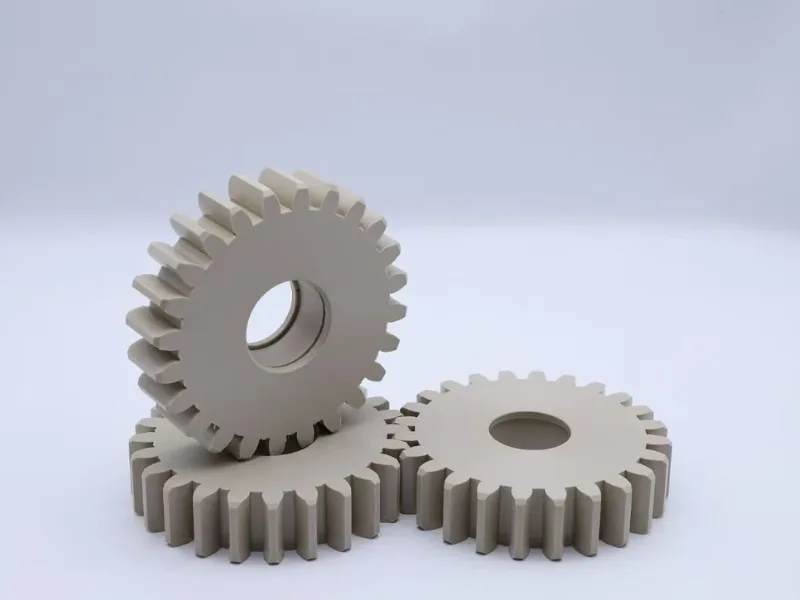
The current industry trend is focused on reducing costs while simultaneously improving performance and efficiency, achieving weight reduction, and driving miniaturization. In gear applications, engineers are seeking innovative materials to replace existing metals or to upgrade typical polymer solutions to meet the demanding performance requirements of future systems.
In recent years, PEEK (Polyetheretherketone) high-performance polymers have been successfully implemented as alternative materials across a wide range of industrial uses. To support this ongoing trend, Changzhou Junhua provides extensive resources to assist customers directly in processing, design, and application development.
Performance Advantages
Gears must satisfy complex, multi-functional requirements because different types of loads often occur simultaneously. The reliable operation of a gear depends on superior tribological (friction/wear) and mechanical properties, resistance to aggressive media, durability, thermal stability, and dimensional precision.
PEEK polymers offer a unique combination of properties perfectly suited for gear applications. By combining the high repeatability of injection molding with exceptional design freedom, PEEK serves as an ideal candidate for replacing metal and enhancing standard engineering plastic gears, delivering significant added value.
Key Characteristics of PEEK Polymers
High Mechanical Strength: Maintains integrity even at elevated temperatures.
Dynamic Fatigue Resistance: Exceptional performance even at temperatures exceeding 120°C (248°F).
High Strength and Toughness: Balances rigidity with impact resistance.
Low Coefficient of Thermal Expansion (CTE): Ensures stability across temperature fluctuations.
Excellent Chemical Resistance: Withstands solvents, lubricants, fuels, and aggressive chemicals.
Superior Friction and Wear Resistance: Minimizes energy loss and extends component life.
High PV Rating: Allows the material to function in demanding, high-pressure, and high-velocity tribological environments.
Low Moisture Absorption: Guarantees dimensional consistency and enhances overall stability.
Increased Design Flexibility: Enables complex geometries that are difficult to achieve with metal.
Ease of Processing: Injection molding ensures high precision and high-volume production efficiency.
Notably, because PEEK’s properties and dimensions remain stable despite high temperatures and humidity, it holds a significant advantage over typical polymer gear materials. For instance, PEEK is used in various under-the-hood automotive applications where continuous operating temperatures often exceed 120°C (248°F). This polymer meets the industrial demand for longer service life in increasingly harsh environments.
Ongoing gear testing (such as those conducted by Changzhou Junhua) highlights PEEK’s ability to handle high-load conditions. This empowers engineers to pursue miniaturization—designing smaller PEEK gears to reduce weight, lower costs, and shrink the overall system footprint.
Application Fields
Medical
In medical applications, PEEK gears offer more than just mechanical strength; they excel in radiation resistance, low particle generation, wear resistance, chemical resistance, and sterilization compatibility.
Example: PEEK gears are used in the transmission mechanisms of 3D imaging systems to help reduce patient radiation exposure.
Example: To ensure the precise dosage and flow of dialysate, dialysis pumps are equipped with gears injection-molded from tribologically modified PEEK.
Automotive
PEEK has seen continuous success in the automotive sector due to its higher performance, lower weight, and reduced production costs.
Specific Uses: Seat adjustments, door control modules, Electric Parking Brakes (EPB), and engine components.
The combination of high toughness and resistance to grease, gasoline, and brake fluid makes PEEK an ideal solution for modern automotive systems.
Business Machines
Gears in printers or copiers must operate at temperatures exceeding 200°C (392°F), often without lubrication. Furthermore, the demand for longer service lives and faster printing speeds is rising.
Specific Uses: PEEK has proven its superior performance in high-demand areas like fuser rollers or heating roller gears.
Industrial
Within the broad industrial sector, PEEK gears are widely used in textile machinery. High-end weaving and knitting machines require extreme wear resistance, light weight, mechanical strength, and heat resistance.
Benefit: Replacing traditional polymer gears with PEEK extends service life and reduces downtime, thereby lowering overall production costs.