

Blog
Engineering Guide: Selecting Virgin vs. GF30 vs. CF30 PEEK

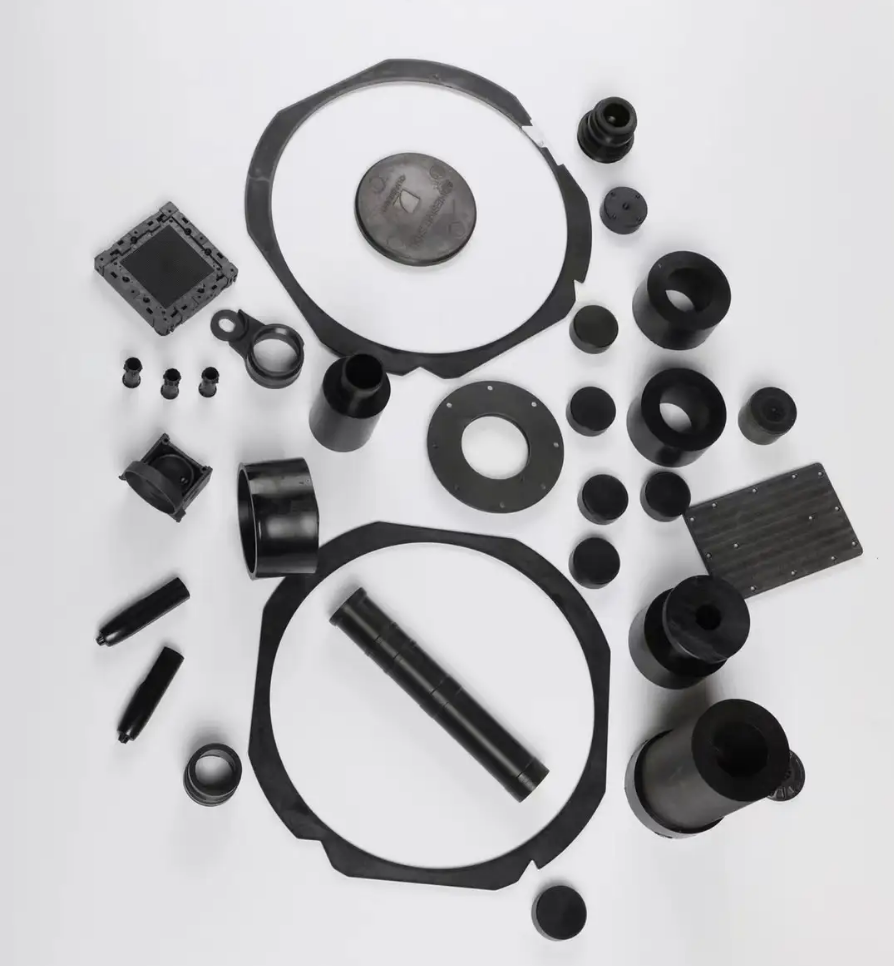
Polyetheretherketone (PEEK) represents the apex of semicrystalline high-performance thermoplastics within the PAEK family. Capable of continuous service at 250°C to 260°C (482°F to 500°F) without structural degradation, PEEK bridges the performance gap between engineering plastics and structural metals.
However, choosing between Virgin Unfilled PEEK, 30% Glass-Filled (GF30), and 30% Carbon-Filled (CF30) dictates the success or failure of mission-critical components.
This guide examines PEEK’s molecular architecture and delivers a clear decision matrix for engineering grade selection.
1. Molecular Architecture: Why PEEK Outperforms Metals
The chemical formula of PEEK is (C₁₉H₁₂O₃)ₙ, featuring a repeating backbone structure:
-[O-Ph-O-Ph-CO-Ph]ₙ- (where Ph represents an aromatic phenylene ring)
Unlike aliphatic polymers, PEEK’s mechanical stiffness and chemical resistance stem directly from the synergy of its molecular building blocks:
- Aromatic Benzene Rings (~76% Carbon Backbone): Impart extreme chemical resistance against fuels, harsh acids, and bases. They resist UV/radiation degradation and prevent chain scission under high mechanical loads.
- Ketone Linkages (–CO–): Provide molecular chain stiffness, giving PEEK a high Glass Transition Temperature (Tg = 143°C) and Crystalline Melting Point (Tm = 343°C).
- Ether Linkages (–O–): Introduce flexible rotary bonds into the rigid aromatic backbone, delivering high impact toughness, elongation, and melt-processability.
2. Material Grade Selection Matrix
Adding glass or carbon fibers drastically modifies PEEK’s mechanical modulus, thermal expansion, and electrical conductivity.
1. Virgin (Unfilled) PEEK: Maximum Purity, Insulation & Ductility
- Key Attributes: Highest elongation at break (>15%), complete electrical insulation, ultra-low ionic impurities, and inherent biocompatibility (FDA / ISO 10993).
- Best Used For: Semiconductor wafer processing, food/medical contact parts, dynamic fluid seals, valve seats, and high-dielectric electrical insulators.
2. GF30 PEEK (30% Glass Fiber): Cost-Effective Structural Rigidity
- Key Attributes: More than doubles flexural modulus (~9.5 GPa vs. 3.8 GPa of virgin) while retaining total electrical insulation. Cuts the Coefficient of Linear Thermal Expansion (CLTE) by more than half.
- Best Used For: High-voltage structural housings, chemical pump bodies, valve plates, and high-load static brackets.
- ⚠️ Engineering Note: Abrasive nature. Avoid dynamic friction against soft mating metals (e.g., aluminum).
3. CF30 PEEK (30% Carbon Fiber): Ultimate Strength & Wear Resistance
- Key Attributes: The true metal-replacement grade. Delivers highest tensile strength, maximum stiffness (flexural modulus >11 GPa), superior creep resistance, and extended fatigue life.
- Electrical Behavior: Carbon fibers make the material electrically conductive / static-dissipative (Volume Resistivity: 10²–10⁵ Ω·cm) and improve thermal conductivity.
- Best Used For: High-PV journal bearings, dynamic wear rings, transmission thrust washers, compressor vanes, and aerospace flight brackets.
3. Quantitative Property Comparison
| Property | Test Standard | Virgin PEEK | GF30 PEEK | CF30 PEEK |
| Density | ISO 1183 | 1.30 g/cm³ | 1.51 g/cm³ | 1.41 g/cm³ |
| Tensile Strength | ISO 527 | 100 MPa | 160 MPa | 210 MPa |
| Flexural Modulus | ISO 178 | 3.8 GPa | 9.5 GPa | 13.0 GPa |
| Elongation at Break | ISO 527 | >15% (Ductile) | 2.5% | 1.8% (Brittle) |
| Thermal Expansion (CLTE) | ISO 11359 | 55 × 10⁻⁶ / K | 22 × 10⁻⁶ / K | 15 × 10⁻⁶ / K |
| Electrical Insulation | IEC 60093 | Insulative (>10¹⁵ Ω) | Insulative (>10¹⁴ Ω) | Conductive / ESD (<10⁵ Ω·cm) |
| Relative Material Cost | Commercial | Baseline | +15% ~ +25% | +40% ~ +60% |
4. The 10-Second Selection Checklist
- Choose Virgin PEEK if: Your application requires electrical insulation, high impact ductility, FDA compliance, or soft sealing compliance.
- Choose GF30 PEEK if: You need high mechanical stiffness and tight dimensional stability under load, but must maintain total electrical insulation at an economical cost.
- Choose CF30 PEEK if: You are replacing aluminum, titanium, or bronze under high-load, continuous fatigue, or high wear/PV limits—and electrical conductivity is either acceptable or required.