

Blog
The Thermodynamics of PEEK: Microstructural Evolution, Thermal Watersheds, and Dynamic Strain Behavior


Polyetheretherketone (PEEK) is widely recognized as the apex polymer within the PAEK (polyaryletherketone) family. Renowned for its retention of mechanical integrity in hostile environments, it serves as an indispensable material across aerospace structures, deep-sea exploration, and biocompatible medical implants.
However, PEEK is not an inert, static material. Its mechanical envelope is governed by dynamic thermodynamic states. From room-temperature stability to high-temperature phase transitions and high-velocity mechanical shocks, PEEK undergoes distinct morphological rearrangements.
This technical analysis explores the thermodynamic mechanics of PEEK across critical thermal and kinetic regimes.
1. The Morphological Shift: Recrystallization and Structural Tuning Below Melting Point
A defining feature of PEEK’s semi-crystalline architecture is its ability to undergo secondary crystallization prior to melting (Tm≈343∘C).
- Molecular Chain Mobility: As ambient thermal energy increases above the glass transition region, PEEK’s stiff aromatic polymer backbones gain rotational mobility. Amorphous regions reorganize into denser, highly ordered crystalline lamellae.
- Thermal History & Annealing: Controlled thermal post-curing (annealing) deliberately increases crystalline perfection and overall crystallinity levels (typically 30% to 35%). This molecular densification enhances modulus, improves creep resistance, and limits dimensional drift.
- Implications for Additive Manufacturing: In high-temperature FDM/FFF 3D printing, maintaining a heated chamber above
160∘C160∘Cdirectly controls the cooling gradient. By managing thermal history during deposition, engineers can eliminate interlayer delamination, tailor crystalline distribution, and produce functional parts with isotropic mechanical strength.
2. The 250°C Thermal Watershed: Continuous Service vs. Viscoelastic Decline
In engineering design, understanding PEEK’s performance curve across two thermal inflection points is essential:
codeCode
[23°C Ambient] ────> [~143°C: Tg (Ductility Shift)] ────> [250°C: Continuous Service Limit] ────> [343°C: Tm (Melt)]- The
TgTgTransition (~143°C / 289°F): At the glass transition temperature, PEEK transitions from a rigid, glassy state to a leathery, viscoelastic state. Tensile modulus drops noticeably (by approximately 50–70%), accompanied by a marked increase in elongation at break. - The 250°C (482°F) Critical Boundary: 250°C represents PEEK’s recognized Continuous Service Temperature (UL 746B). Below this threshold, stabilized crystalline domains support mechanical loads effectively.
- Beyond 250°C: As temperatures approach the melt regime, thermal softening accelerates rapidly. Creep rates spike sharply, and intermolecular forces deteriorate, precluding its use in load-bearing structural designs unless reinforced with carbon (CF30) or glass fibers (GF30).
3. Physiological Stasis: Why PEEK Remains Thermodynamically “Inert” in the Human Body
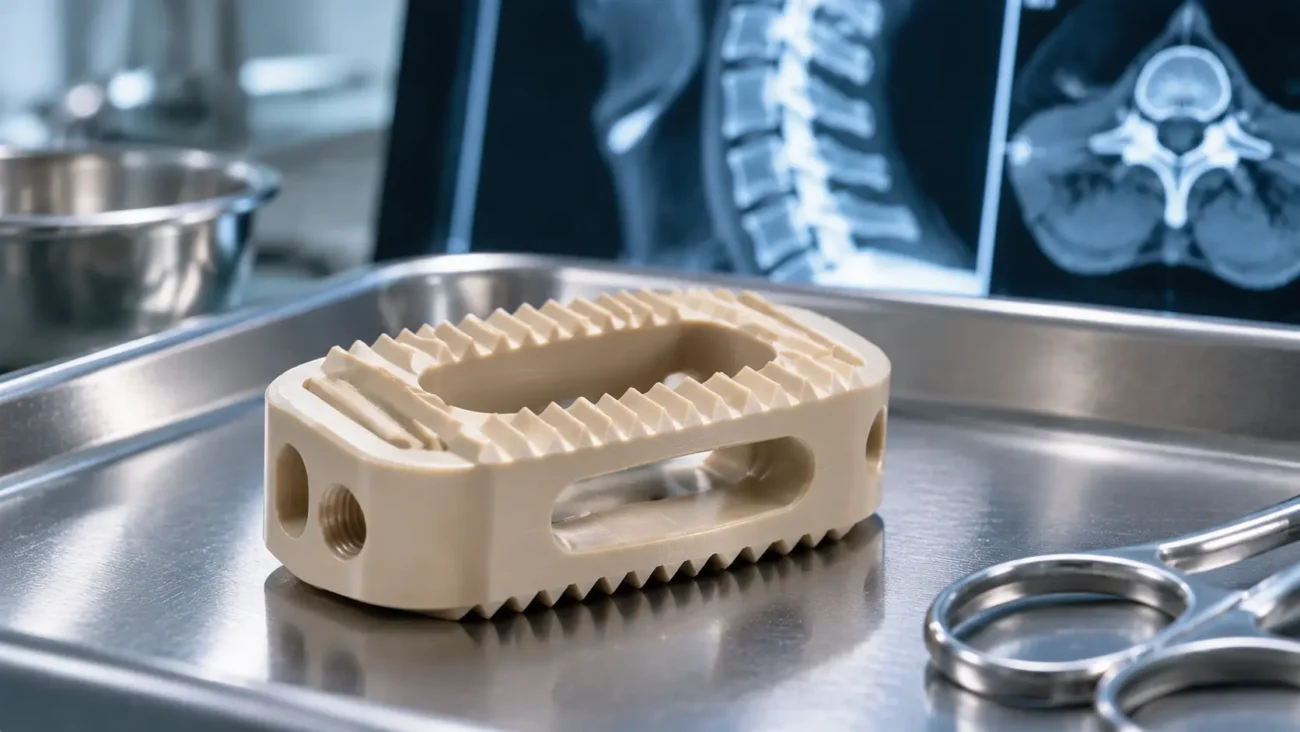
While industrial PEEK is valued for its response to heat, medical-grade PEEK (such as PEEK-OPTIMA) is prized for its thermodynamic and biological stasis inside the human body.
- Far Below Glass Transition: Normal human core temperature operates at approximately
37∘C37∘C—over100∘C100∘Cbelow PEEK’s glass transition threshold. Within this physiological window, the polymer exhibits near-zero viscoelastic drift, maintaining dimensional stability for spinal cages, cranial plates, and orthopedic fixations. - Iso-Elastic Matching: Unlike metallic alternatives (Titanium or Cobalt-Chrome), PEEK provides an elastic modulus (~3.6 to 4.0 GPa unfilled) that closely mimics human cortical bone (~10 to 18 GPa). This mitigates the risk of stress shielding and bone resorption.
- Stability Under Micro-Friction: In dynamic articulating environments (e.g., partial joint assemblies), localized friction can generate transient thermal spikes. PEEK’s high heat distortion threshold ensures that micro-thermal fluctuations cause no degradation, surface micro-cracking, or cytotoxic leachables.
4. Counterintuitive Kinetics: High-Rate Compression and the Strain-Rate Hardening Effect
Beyond thermal dynamics, PEEK demonstrates fascinating mechanical behaviors when subjected to rapid kinetic loading, governing by the Time-Temperature Superposition Principle.
In polymers, high-rate physical impact functions analogously to a sharp drop in material temperature:
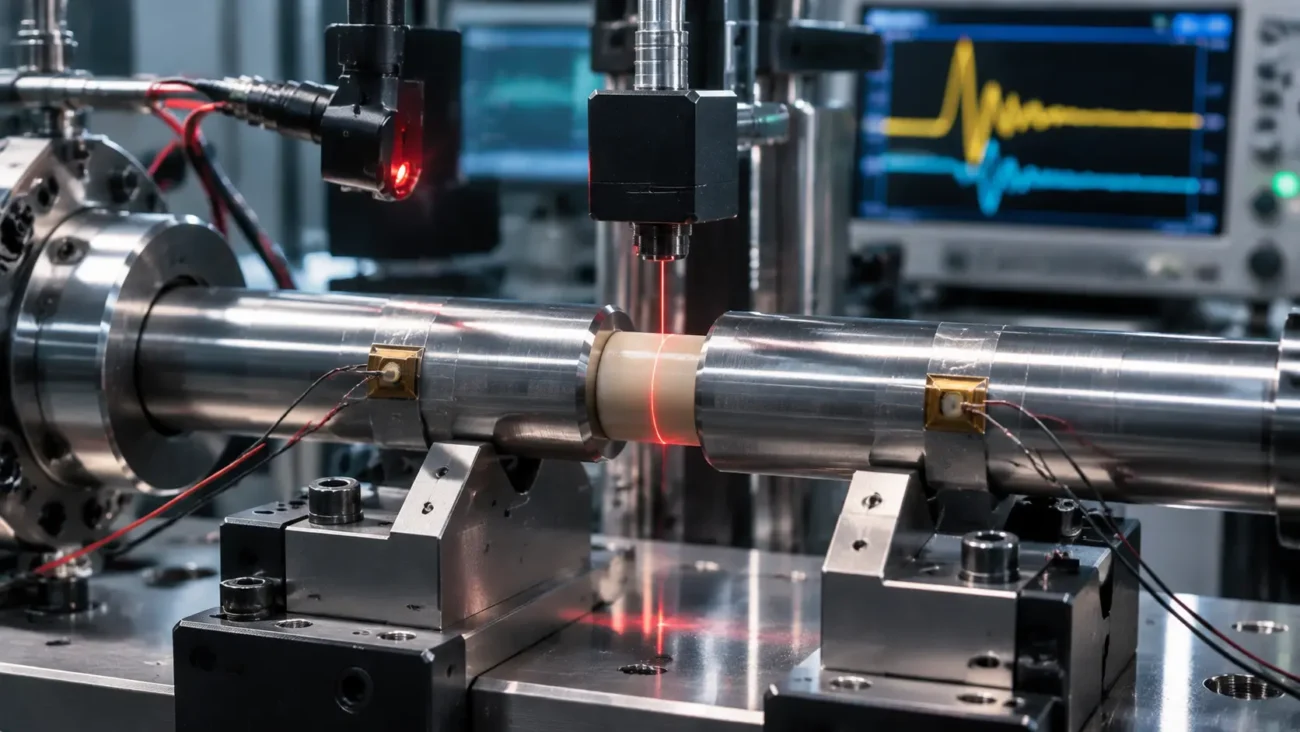
- The Strain-Rate Spectrum: When subjecting PEEK to compression testing across regimes spanning quasi-static loading (
10−4 s−110−4 s−1) to explosive, ballistic impact (104 s−1104 s−1via Split-Hopkinson Pressure Bar tests), its yield behavior transforms significantly. - The 30% Yield Strength Surge: Under extreme strain rates (
∼104 s−1∼104 s−1), PEEK’s compressive yield strength increases by up to 30%. - Micro-Mechanical Mechanism: Under near-instantaneous ballistic or shock impact, entangled polymer chains lack the relaxation time required to slide, disentangle, or yield via normal plastic flow. The microstructure exhibits strain-rate hardening, absorbing mechanical energy instantaneously through elastic lattice compression rather than brittle shattering.
Engineering Takeaways for Material Selection
PEEK’s behavior across thermal and mechanical gradients confirms its position as a uniquely adaptable engineering polymer:
- For Thermal Processing: Utilize controlled thermal annealing (160°C–200°C) to maximize crystallinity, eliminate internal stresses, and improve chemical barrier properties.
- For High-Temperature Design: Ensure operating mechanical loads remain below the
TgTg(143°C) threshold unless designing with fiber-reinforced composites up to the 250°C ceiling. - For High-Impact Applications: Exploit PEEK’s strain-rate hardening effect for aerospace fairings, military armaments, and downhole drilling tools where dynamic shock mitigation is vital.
Need Custom PEEK Engineering or Machining Services?
Leveraging deep expertise in high-performance polymers, our facility provides precision-machined and customized PEEK components tailored to your application’s exact thermodynamic requirements.
[Consult with Our Materials Engineering Team Today]